I grew up in New England in the countryside, outside New York City. The house and the landscape still resonate deeply within me. My mother painted, and she gave me a wonderful childhood and a passion for art—such as I remember it in New England as I Remember It. The door lets in light, the garden beckons from outside. I painted it during the pandemic when New England was hit especially hard.
New England as I Remember It, 2020
Oil on canvas | 130 x 160 cm | Private collection
Only Love’s Pleasures Touched My Heart, 1994
Oil on canvas | 130 x 160 cm | Private collection
In Only Love’s Pleasures Touched My Heart, I arranged the props in twos, close together as in pairs, enveloped by a sky-blue background. The space was so shallow, only three to four meters deep, so I could have the illusion of reaching up and touching all the surfaces with the paintbrush. I myself am always present in the rooms I paint, and during the painting process, I imagine myself standing at the lower edge of the canvas with my hand following the floor inwards, upwards, along the wall, before I nudge the objects into the right place. By touching all parts of the room with the brush, the room becomes mine. I identify with the room. The objects are selected with care, and some have followed me since childhood. I give them roles and functions, take a long time to find the right arrangement. The drama plays out in the relationships between the objects within the confines of the space. Each layer of paint adds volume and depth. Each new object opens up for a new narrative. For example, when I introduced a mirror, I was able to capture the world outside and at the same time keep the world outside as only a reflection, an illusion.
In He Is Not Dead; He Is Only Sleeping, the objects stand apart from each other, almost deserted and left to themselves. One can also see them as a trio. The glass sheet under each piece of furniture lies there like a well.
He Is Not Dead; He Is Only Sleeping, 1994
Oil on canvas | 130 x 160 cm | Private collection
House of Protection, 1995
Oil on canvas | 160 X 130 cm | Grieg Foundation
In House of Protection, the objects are intertangled in an intimate, secretive way. The reflections from the glass surface break through the surface. A stool points towards us; does it invite us to participate in the family secret?
A canvas primed with blue leans against the ‘thigh’ of a tall pink stand. The stool, which stands on its head, symbolizes a child and play; the black sheet of glass reflecting the objects is the subconscious. Embodiment shows the essence of how I see myself: standing, with a soft shadow.
Embodiment II, 2025
Oil on canvas | 150 x 120 cm | Private collection
And the rest is silence, Hamlet Act 5, Scene 2, 2004
Oil on canvas | 130 x 160 cm | Private collection
My pictures have a bit in common with theatre because I arrange the room as would a scenographer. It was therefore natural to choose the play Hamlet, by William Shakespeare, after a visit to Kronborg Castle. Hamlet is as relevant today as it was 400 years ago—everyone can relate to the drama. I identify with Hamlet because he loses his father about the same age as I was when my mother died. His mother remarries shortly thereafter, as my father did, and Hamlet struggles to understand what went wrong. I spent three years painting the Kronborg pictures, and all the while, I thought about how Hamlet experienced his childhood home. In Hamlet’s day, Kronborg Castle was Northern Europe’s most important center of power, but for Hamlet, it turns into a prison. He sees light but can’t find the way out. Hamlet’s famous last words in Shakespeare’s play provided the title for one of the pictures I painted at that time: And the rest is silence.
To escape from Hamlet’s darkness, I painted a series in white. Support shows a quiet dialogue between my old, faithful table and a freshly stretched canvas. I associate the table with what is feminine. It can carry a lot of weight and bids us welcome. Together, the table and the canvas form an alliance. The shadow they cast is as large as they themselves are. The shadow has its own identity and is as significant as the objects. What is real and what is unreal are side by side and have equal weight.
Support II, 2006
Oil on canvas | 130 x 160 cm | Private collection
Ulf’s Studio III, 2005
Oil on canvas | 130 x 160 cm | Private collection
Light in a painting is present tense. Light represents something moving, the moment here and now, in contrast to the static, unchanging interior, the furniture, walls and floor that I think of as the past. Chairs for me are people—this is of course why we refer to chair legs and chair arms. The chair is the self. It’s made and adapted to you and me. Light strikes like a lightning bolt and topples the chair in Ulf’s Studio.
In Looking into the Light, the theme is the silent stillness of light. I wanted to create a sense of timelessness with windows showing only a cold white light making the rooms even more silent and still.
Looking into the Light, 2020
Oil on canvas | 120 X 150 cm | Grieg Foundation
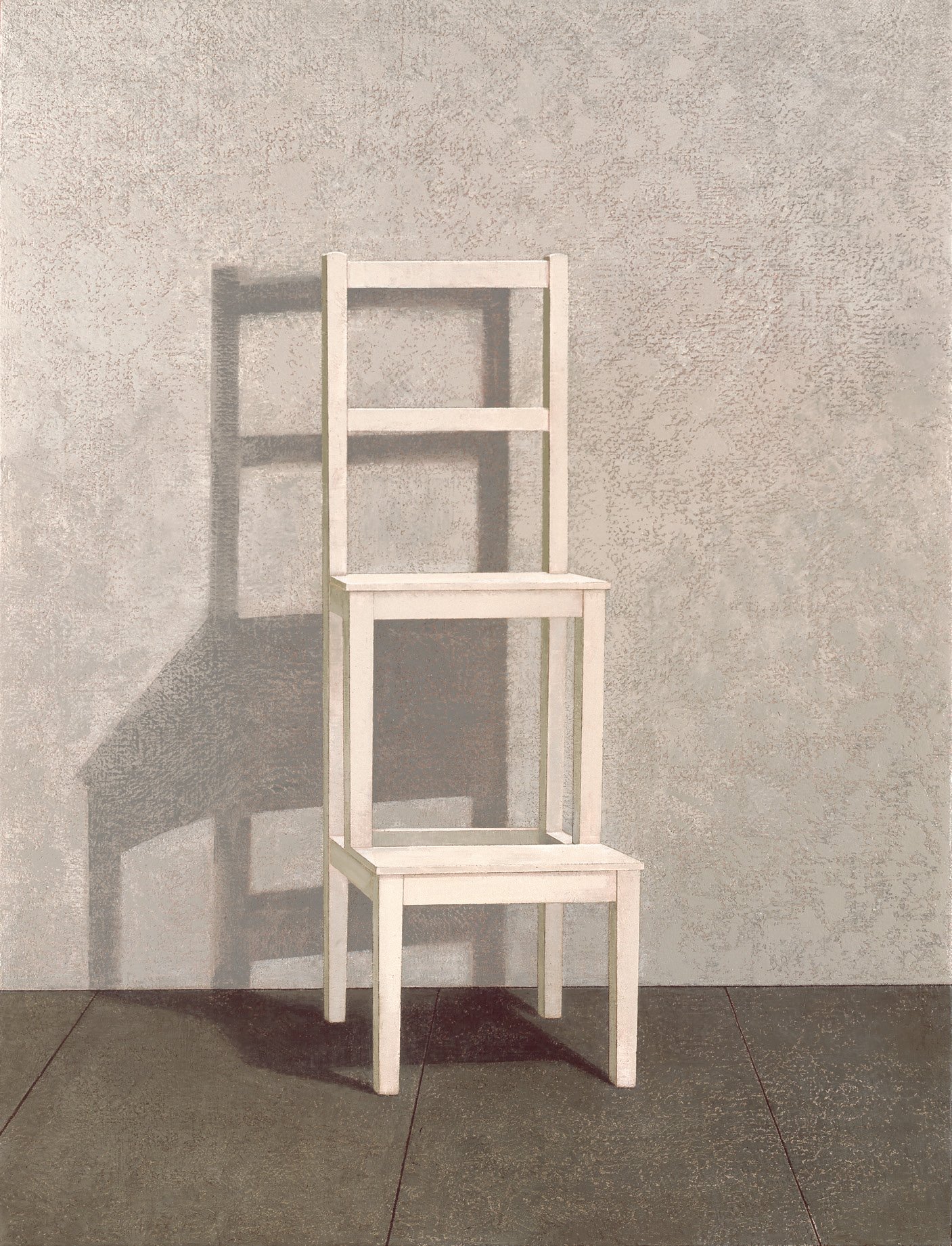
Examination Chair, Dermatology Department, 1991
Oil on canvas | 150 x 112 cm | On loan from Oslo University Hospital
Just as other figurative painters search for models, I search for tables, chairs and stools. I found an examination chair in an auditorium at the dermatology department of the old Oslo University Hospital (Rikshospitalet). Back when the chair was in use, it was customary for patients to have to undress and climb up onto this high chair to display their skin disease to a packed auditorium of professors and medical students. This was humiliating as far as patients were concerned, and the practice has now been discontinued at the hospital. Examination Chair, Dermatology Department reminds us of an earlier time.
My paintings have gone from the darkness of Hamlet, to a series of light paintings, and back to darkness again. In Visitor in the Night, it became even darker due to a fire in my daughter’s apartment that turned her rooms completely black. This affected me so deeply that I, for the first time, painted on a black ground. Over time, as the renovation progressed, I searched for a light that could reawaken the objects and bring them back to life. Light has a transformative power.
Visitor in the Night, 2008
Oil on canvas | 160 x 130 cm | Private collection
Trøndelag Kitchen from the Norwegian Folk Museum, 2019
Oil on canvas | 150 x 120 cm | Private collection
History interests me—not just my own, but that of others. I think it comes with age. When one has one’s own history to relate to, it’s easier to understand and take an interest in how people used to live. At the Norwegian Folk Museum there are some farm buildings from 1959. The kitchen in the main house is actually large and well lit, but I chose to paint it cramped and dark, so the eye is drawn towards the window and the light outside. I was a little girl in 1959 and was taught that a woman’s place was in the kitchen. Things have changed since then. But the division of labor in the home is, in my opinion, still one of the most important equality-related issues in Norway today, and it remains unresolved. It was therefore especially important for me to paint Trøndelag Kitchen from the Norwegian Folk Museum.
Painting rooms has been vital for me. The floor was a platform on which I stood, the walls were my framework. I wasn’t into realism but I wanted my rooms to be real. Believable. This is no longer the case; the rooms I now paint are clearly fiction, and the landscape outside tells us we aren’t necessarily in the cold north. One could say The Uninvited Table is about something foreign with an open door. It’s of course already in the title—that the table is like an uninvited guest who doesn’t fit in. But the picture is also about the process of creation, about letting chance play a role. What happens to the room, and the painting, when the table doesn’t belong there? I worked on this painting for a long time without including any furniture. Then one day I thought: What happens if I put a table in it? Ovals can be beautiful shapes, but this particular table, with its strange legs, was a challenge. The table as a subject has followed me throughout my whole career. I associate it with femininity and softness. But I hadn’t worked with oval shapes before. When I started painting, my tables were often simple, angular and defined surfaces. It wasn’t easy to gain acceptance as a female painter back then. But times have fortunately changed over the past fifty years. And I’ve changed too. Now I fell for this organic, feminine form.
The Uninvited Table, 2025
Oil on canvas | 150 x 120 cm | Private collection
Shadow Takes the Seat, 2025
Oil on canvas | 150 x 120 cm | Private collection
Properties of light have always interested me. Light defines space, reveals form, and, most importantly, gives life to the painting. Over the years the contrast between light and shadow has become more pronounced. In Shadow Takes the Seat, we look into a glass veranda. A rattan chair on the outside casts its shadow into the room. The shadow’s pattern can recall a spiderweb, and it gives the picture the contrast I wanted—a counterpoint to the garden’s lyrical sweetness.
In Smudges for Mondrian, we look into a glass veranda with white marks on the sliding glass doors. The black, vertical and horizontal lines form a strict graphic schema that immediately summons Piet Mondrian’s grid compositions from the 1920s. But instead of adhering to flatness and pure abstraction, I’ve painted a grid from an angular perspective that opens up for a landscape. In this way, Smudges for Mondrian stands as both a homage and a contrast—a grid that opens up for the imperfect.
Smudges for Mondrian, 2025
Oil on canvas | 150 x 120 cm | Property of the artist
The Fire Still Burns, 2022
Oil on canvas | 120 x 150 cm | Private collection
When I painted The Fire Still Burns, I thought about late summer—the time when summer glides into autumn and then towards winter. I was interested in how the landscape outside affects the internal rooms. In this picture the landscape has a paleness; it’s almost as if it’s on the verge of being erased, while the autumn colors are cast into the room. The blue walls can be read as an intense sky. Juxtaposed with the flat red-brown wallpapered surface in the foreground, it can put one in mind of autumn leaves. Maybe the shadow on the floor suggests the winter’s crystals and chill?
In Behind the Blinds, we see the corner of a room painted in a distinctive and dark color. Our gaze is drawn out through the window, such that the silent interior is merely suggested in the reflection on the wardrobe door and in the subtle light falling on the floor. I wanted to emphasize the room’s stillness—the color’s psyche—and direct the gaze outwards, towards the room across the street.
Behind the Blinds, 2025
Oil on canvas | 150 x 120 cm | Property of the artist
Held in Blue, 2025
Oil on canvas | 150 x 120 cm | Private collection
In Held in Blue, I explore how the inner and the outer rooms can meet. The tables, almost floating, exist in a kind of cosmic state, and the distinction between the wall and the floor disappears. There’s something about the place where the wall meets the floor, the tension arising when the vertical meets the horizontal. Something happens there. Maybe it’s because the floor is the platform I stand on in life, and the walls are the boundaries, the necessary limitation? The environment outside, the building façade and the roof, give a feeling of absence, but the suggestion of the green tree offers a sign of life. The picture’s basic tone is a dark-blue night sky and alludes to a time of day when outside and inside meet.
Nostalgia, 2009
Oil on canvas | 130 x 160 cm | Private collection
